
- Hand Hygiene
- Life of a Wildlife Carer
- Dirty Wounds? We have the solution!
- Pet Of The Month
- The Basic of Fluid Therapy
- Joint disorders in dogs and corrective procedures
- The differences between TPLO, TTA and MMP cranial cruciate ligament rupture surgery
- Body And Muscle Condition Scoring
- Fluid Therapy - Rehydration Calculations
- Hand Hygiene in Veterinary Medicine: From History to Modern Practice
- DEHP free IV lines & consumables
A simple way to reduce DEHP exposure during everyday IV therapy
In vet patients - especially cats and small dogs - we dose and monitor so much “per kilo” that small differences can add up. During IV therapy we naturally focus on the medicine, the dose and the response, but the tubing and connectors can also influence exposure to substances that may migrate into the fluid - particularly for smaller or higher‑risk patients.1,2,13
A lot of standard giving sets are made from PVC that’s been softened with DEHP. Because DEHP isn’t chemically bound to the PVC, it can migrate into IV fluids—especially with longer hang times, warming, or certain drug formulations.1,2,3,4
The good news: where alternatives are available, clinics can reduce exposure simply by choosing DEHP‑free IV lines and consumables - and confirming materials with the supplier when needed.1,3
Why DEHP matters in veterinary practice
What is DEHP?
DEHP (di(2‑ethylhexyl) phthalate) is a manufactured chemical used as a plasticiser to make PVC flexible. It’s been widely used in medical devices such as fluid bags and tubing.2,3,13 Because DEHP sits within the plastic rather than being chemically bonded, it can leach into fluids that contact the device. In some IV scenarios—particularly with longer contact time or certain formulations—this can mean higher exposure than day‑to‑day background sources.1,2,3,4,13
Why DEHP leaches from PVC IV lines
Leaching tends to increase when fluids sit in the line for longer, when sets are warmed, and when lipid‑ or surfactant‑based formulations are used. Infusion conditions (including pump delivery) may also play a part.1,2,8,9,10,11
In the EU, DEHP is classified as toxic to reproduction (reproductive and developmental toxicity).4 In day‑to‑day IV therapy, smaller patients can end up with proportionally higher exposure - especially if they need multiple lines/sets or prolonged infusions.2,7,8,13
Common clinic scenarios can increase exposure - think warmed fluids, long CRIs, pump delivery and extended hang times. Put simply: the longer fluid is in contact with PVC tubing, extension sets or connectors, the more opportunity there is for DEHP to migrate.1,5,6,8
Why this distinction matters clinically
- With lipid/surfactant formulations, migration can happen faster and at higher levels.1,9,10,11
- Even with lower‑risk fluids, exposure can build over time when contact time is long and sets are used continuously.1,2,5,8
- That combination is common in practice—especially in ICU, long hospital stays and cases needing CRIs or lipid‑based products.1,2,5,8,9,10,11
- Using DEHP‑free lines and consumables (where appropriate) is a straightforward way to reduce that exposure.1,2,3
Drugs more likely to increase DEHP migration
The type of drug or solution running through IV tubing and consumables is one of the strongest predictors of DEHP leaching.1,10,11
Higher risk drugs include those that are lipid based, contain surfactants or are infused over long periods.1,10,11 Examples of commonly used drugs that can pose a risk include:
High risk (formulation‑driven) — included when the drug:
- Is lipid based1,9,10
- Contains surfactants1,11
- Uses oily or organic solvents1,11
Examples
- Lipid emulsions (e.g., propofol or parenteral nutrition lipids) are associated with higher DEHP extraction from DEHP‑plasticised PVC infusion sets compared with non‑lipid infusates.9,10
- Some IV drugs and formulation components (including surfactants/solvents used in certain oncology medicines) can increase extraction of DEHP from PVC.11,12
- Cyclosporine, tacrolimus (surfactant formulations).11
- Diazepam (oily/organic vehicle).11
- Medicines containing surfactants (e.g., polysorbates) or lipid carriers.11
Key point:
Lipid/surfactant formulations can extract (mobilise) DEHP from DEHP‑plasticised PVC, and this can occur even over relatively short contact times.1,8,9,11
Moderate–high risk (formulation + time)
- Included when the drug:
- Contains surfactants or solvents.1,11
Is given slowly, repeatedly, or over longer infusions1,8
Examples
- Cyclosporine or tacrolimus administered as slow or repeated infusions.11
- Other surfactant‑ or solvent‑containing medicines where contact time is prolonged (confirm formulation and compatibility information with the medicine’s product information and supplier).1,11
Key point:
The formulation increases risk and longer contact time amplifies DEHP migration.1,2,8
Moderate risk (time/mechanics‑driven)
Driven by time, pressure, and mechanics — not the drug
Included when IV therapy involves:
- Prolonged contact time1,8
- Infusion conditions (e.g., continuous flow, pump delivery).5,6,8
- Continuous flow through PVC devices5,6,8
Examples
- Long continuous infusions (CRIs), where IV tubing has prolonged contact with fluids and is often used with extension sets/connectors.1,8
- Infusion pumps / pump delivery (an infusion condition that may influence migration alongside time and temperature).5,6,8
- Extended fluid hang times in hospitalised patients.1,8
- Small patients receiving multiple infusions and/or multiple sets/lines/connectors over time can have higher exposure on a body‑weight basis.2,7,13
Key point:
Exposure builds up gradually over time, even with low‑risk fluids.1,5,6,8
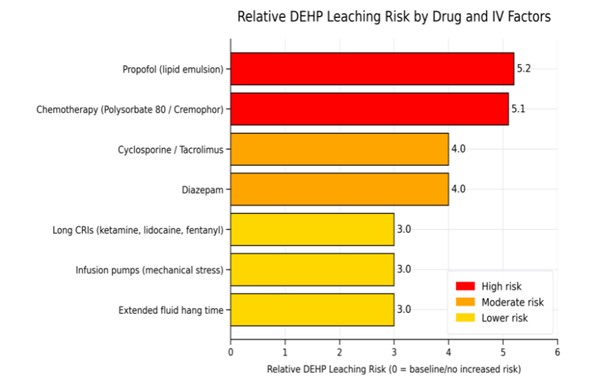
„ Chart - Ref 1,2,5,8,9,11,12“
While standard crystalloids such as saline, Hartmann’s and 5% glucose are generally lower risk on their own, DEHP exposure still increases with time (contact duration), temperature, and mechanical stress across IV lines, extension sets and associated consumables.1,2,5,8
Transparency matters
It’s not always obvious whether a device is made from DEHP‑plasticised PVC. If it isn’t clearly labelled DEHP‑free, it’s worth confirming the material composition with the supplier/manufacturer.1,3
When material composition can’t be confirmed, it’s harder to make a clear risk‑benefit call for higher‑risk patients and procedures.1,3
A straightforward alternative
B. Braun reports it removed DEHP from its IV therapy range and uses alternative plasticisers across its IV giving sets, extension lines and supporting IV consumables.14
B. Braun also states the switch to its DEHP‑free IV products doesn’t change handling, priming or standard protocols.14 Many clinics choose to prioritise DEHP‑free consumables for smaller patients and other higher‑risk cases (for example, long infusions, oncology, or lipid‑based products).2,3
Why choose DEHP‑free
- By switching to DEHP‑free IV lines and consumables, clinics can:
- Reduce DEHP exposure in higher‑exposure IV therapy scenarios (e.g., long infusions, warming, pumps, lipid/surfactant formulations).1,2,3
- Prioritise DEHP‑free options for smaller patients/animals or other higher‑risk cases where feasible.1,2,3
- Align with published guidance recommending precautions/alternatives to limit DEHP exposure in higher‑risk groups where suitable alternatives are available.2,3
A practical clinic approach
1) Use DEHP‑free IV lines, extension sets, burettes and connectors as standard stock
- It reduces exposure without changing the prescribed medicine or dose, and does not require changes to standard IV therapy steps such as priming.14
- It can help reduce DEHP exposure in smaller or higher‑risk patients (e.g., neonates/paediatrics, long infusions, lipid emulsions).2,7,8,9
- It aligns with published recommendations to limit DEHP exposure in at‑risk groups when alternatives are available.2,3
2) Explicitly protect high-risk patients with written protocols for:
- Neonates/juveniles (where relevant).1,2,7
- Oncology patients (some medicines/formulations can increase DEHP extraction).11,12
- Long-term CRIs / prolonged infusions.1,8
- Patients receiving lipid emulsions (e.g., propofol or parenteral nutrition lipids).9,10
- ICU and hospitalised cats and small dogs (smaller patients and multiple procedures/lines can increase exposure on a body‑weight basis).1,2,7,13
3) Ask suppliers direct material questions about their products and document the answers
- Is this product DEHP‑free?”
- “What plasticiser is used instead?”
If you’d like, we can provide written confirmation of DEHP‑free status for relevant B. Braun items (where available).
4) Communicate your materials choice (where appropriate)
Regulators and expert groups have published guidance recommending that healthcare providers consider alternatives and take precautions to limit DEHP exposure for higher‑risk groups where suitable alternatives are available.1,2,3
- A documented approach to selecting DEHP‑free options for higher‑risk patients and procedures.1,2,3
- Supplier verification (asking and recording whether products are DEHP‑free and what alternative materials/plasticisers are used).1,3
- Clear communication to staff about when to prioritise DEHP‑free lines (e.g., long infusions, lipid emulsions, small patients).1,2,8,9,10
If you’d like help mapping out a simple swap list (based on the sets you use most), or you’d like samples to trial, speak with your B. Braun rep.